

- By Neha Duhoon /
- home
How a Bali Villa Operator Built a High-Performance Revenue Engine in Four Weeks
Launching a villa business in Bali is one thing. Building the commercial infrastructure required to turn those villas into a scalable, revenue-generating portfolio is another. For one new Bali villa operator that got in touch with Strategy Cues, the objective was clear: launch quickly, establish the right technology and distribution foundation, build visibility across booking channels, and create a revenue strategy capable of responding to Bali’s changing demand.
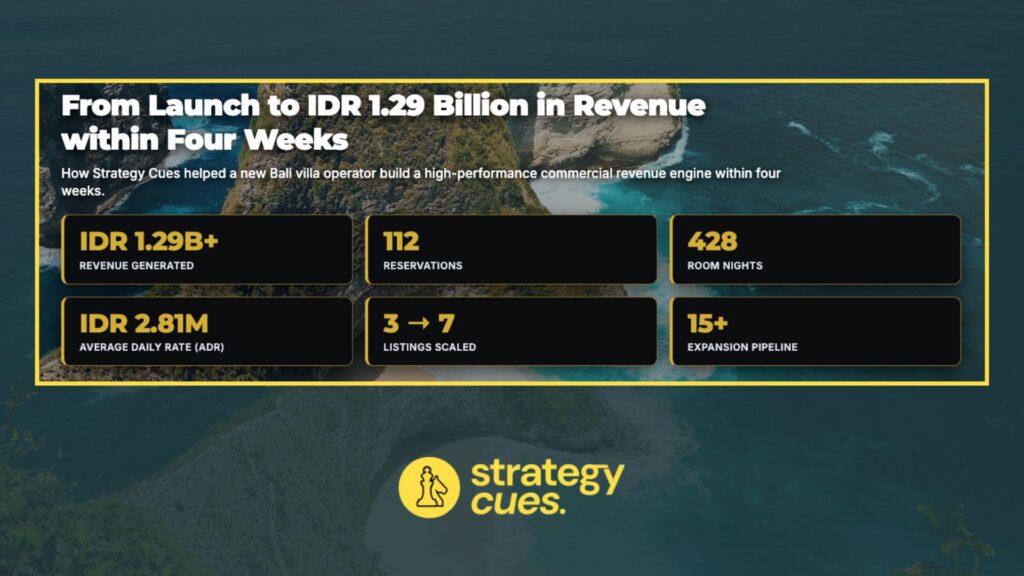
Within the first four weeks of implementing Strategy Cues‘ revenue and distribution strategy, the portfolio generated IDR 1.29B+ in revenue, secured 112 reservations representing 428 room nights, and achieved an average daily rate (ADR) of IDR 2.81M. The portfolio also expanded from 3 initial properties to 7 live listings, with 15+ additional properties in the expansion pipeline.
The results weren’t driven by simply lowering rates. They came from building the right commercial strategy from day one.
Phase One: Building the Commercial Infrastructure
Before pricing could be optimized, the operator needed a connected commercial ecosystem.
Strategy Cues began by establishing the portfolio’s property management system (PMS) architecture, mapping room inventory and connecting the portfolio with major online travel agencies including Airbnb, Booking.com and Agoda. The objective was to create one connected environment where inventory, availability, and rates could move efficiently between systems. Dynamic pricing infrastructure was then introduced through PriceLabs, allowing rates and minimum-stay strategies to respond to changing market conditions rather than relying on static seasonal pricing.
PriceLabs’ dynamic pricing system can automatically update daily rates and minimum stays using factors including seasonality, day of week, supply and demand, and booking lead time. For a growing Bali villa management business, this technology foundation matters because commercial decisions need to scale alongside the portfolio.
Creating Listings Designed to Convert
Distribution alone doesn’t create demand. Every villa also needs to compete for visibility and conversion once it appears in front of potential guests. Strategy Cues developed multi-platform listings tailored to Bali traveler personas, supported by keyword-optimized titles and descriptions, photography guidance and structured commercial policies.
This included establishing flexible, non-refundable and weekly rate plans alongside cancellation policies designed to balance booking conversion with revenue protection.
Listing optimization is particularly important on Airbnb. Airbnb states that its search algorithm considers factors including a property’s quality, popularity, price and location, while listing content, photography, availability and pricing can also influence visibility and guest engagement.
For villa operators, therefore, Airbnb optimization in Bali isn’t simply about writing an attractive property description. Content, pricing, availability, booking restrictions and guest experience all form part of the property’s wider commercial performance.
While additional inventory creates more competition, it also raises the importance of dynamic pricing, listing optimization, and effective distribution strategies to maintain strong occupancy and profitability.
Moving Beyond Static Pricing
Once the portfolio was live, the focus shifted from setup to active vacation rental revenue management. Instead of establishing a nightly rate and waiting for reservations, Strategy Cues implemented dynamic pricing strategies designed around real-time demand.
Rates were continuously adjusted around:
- 1. Changing demand and booking pace
- 2. Bali’s high and low tourism seasons
- 3. Stronger weekend leisure demand
- 4. Local events and holidays
- 5. Booking lead time
- 6. Last-minute opportunities
- 7. Competitor pricing
Length-of-stay controls were also introduced. Dynamic minimum stays helped protect high-demand dates while targeted gap-night strategies created opportunities to sell otherwise difficult-to-fill nights. Last-minute pricing adjustments were used to capture late demand without unnecessarily discounting the wider calendar.
The goal wasn’t to chase occupancy at any price. It was to find the strongest achievable balance between occupancy, ADR and RevPAR.
Turning Bali Market Intelligence Into Pricing Decisions
Revenue management becomes significantly more powerful when pricing decisions are supported by market intelligence. Strategy Cues continuously benchmarked the operator’s villas against relevant local competitors, tracking rate movements and market conditions across Bali. Live indicators including flight arrivals, search volume, booking pace and local events were incorporated into the commercial decision-making process. Performance was then reviewed through detailed analysis of occupancy, ADR, RevPAR and channel mix.
This approach was supported by regular revenue reviews, allowing strategies to change as the market changed rather than waiting for end-of-month performance reports.
Bali’s tourism market makes this particularly important. Indonesia’s official statistics agency, BPS Bali, publishes international visitor arrival data for Bali by month, origin and port of entry—illustrating the depth of demand information available to operators willing to incorporate broader tourism trends into their revenue strategy. Market data becomes valuable when it changes a commercial decision.
Cities such as Cape Town, Johannesburg and Durban, alongside the country’s popular coastal and leisure destinations, continue to attract domestic and international travellers. This creates significant opportunities for operators who use market data and agile revenue strategies to respond to changing demand.
Building Direct Booking Capability From the Beginning
OTAs were only one part of the strategy. Strategy Cues also supported the setup of a direct villa booking engine and multi-currency payment infrastructure, creating another path for guests to reserve properties.
For an operator planning to grow beyond a handful of villas, establishing direct booking capability early helps create a stronger long-term distribution mix instead of becoming entirely dependent on individual OTAs.
The commercial model therefore combines OTA distribution, direct bookings, revenue management, pricing intelligence, and listing optimization within one connected strategy.
The event provided an opportunity to connect with industry professionals, exchange insights and gain a closer understanding of the opportunities and challenges shaping South Africa’s evolving short-term rental landscape.
The First Four Weeks: IDR 1.29B+ in Revenue
The commercial impact was visible within the first month.
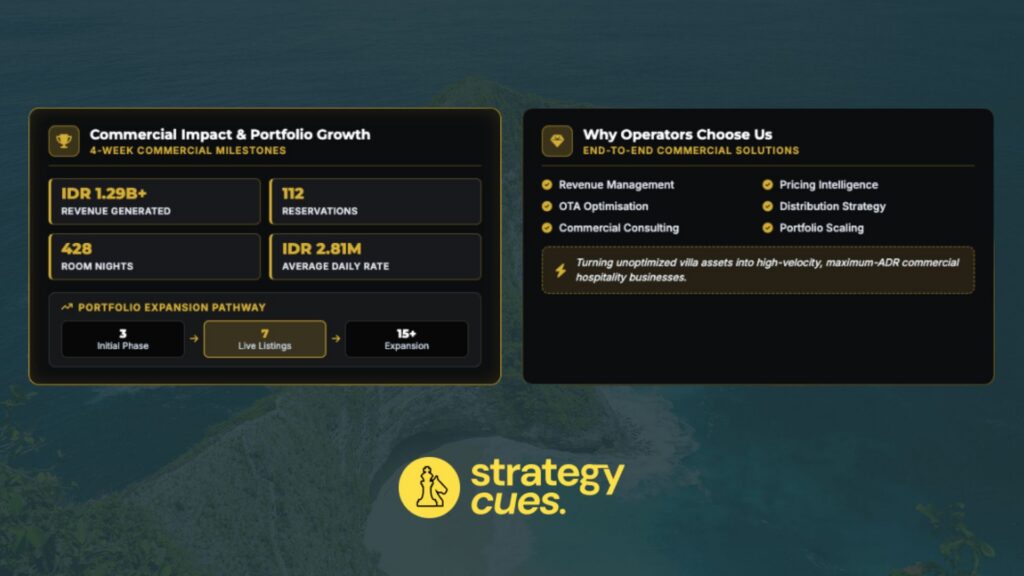
IDR 1.29B+ in revenue generated. 112 reservations. 428 room nights. IDR 2.81M average daily rate.
And importantly, the portfolio itself was scaling. The operator moved from an initial launch phase of 3 properties to 7 live listings, while developing an expansion pipeline of 15+ additional properties.
That growth demonstrates why revenue management for a new hospitality business needs to begin before the portfolio becomes large. The systems, pricing logic, distribution strategy, and reporting structure built for three villas need to be capable of supporting seven, fifteen or significantly more.
At Strategy Cues, we are delighted to be part of this growth story. As we continue supporting hospitality businesses with AI-backed revenue management, distribution strategy and operational intelligence across global markets, we look forward to contributing to South Africa’s evolving short-term rental landscape and helping partners unlock their next stage of growth.
What This Means for Bali Villa Operators
The Bali vacation rental market rewards more than simply having a great property.
Operators need the ability to answer commercial questions every day:
- 1. Should rates move because demand has accelerated?
- 2. Are competitors pricing differently for an upcoming weekend?
- 3. Is a minimum-stay restriction preventing a valuable reservation?
- 4. Could an orphan night be converted?
- 5. Is a listing receiving visibility but failing to convert?
- 6. Which booking channel produces the strongest revenue contribution?
- 7. Should an upcoming event trigger a pricing premium?
Answering those questions requires more than software. It requires a combination of technology, market intelligence, and human revenue strategy. That was the foundation of this Bali portfolio’s first four weeks.
Managing villas in Bali or preparing to scale your hospitality portfolio? Strategy Cues supports operators to build smarter pricing, distribution and revenue strategies designed around their market, properties and growth goals.
More About Strategy Cues:
Operating across 12+ countries, Strategy Cues manages revenue and operations for 2,200+ short-term rental listings worldwide. Powered by AI-driven revenue frameworks and data-based intelligence tools tailor-made for hospitality brands, Strategy Cues partners with leadership teams to drive pricing optimization, profitability, operational scale, onboarding strategy, organizational restructuring, and reputation-led growth.
