

- By Neha Duhoon /
- home
The Middle East hospitality market is navigating one of its most volatile periods in recent years. Airspace disruptions, flight suspensions, and shifting government advisories have created an environment where demand visibility changes almost daily.
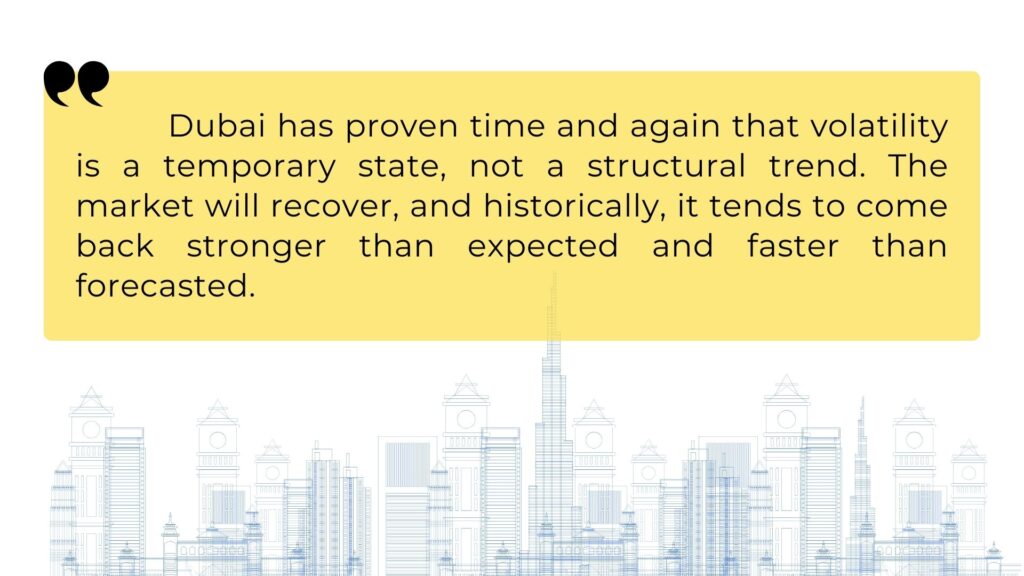
Yet, if history has shown anything, it is this: Dubai does not break—it rebounds.
Across the region, every major shock like economic downturns, geopolitical tensions, or operational disruptions has historically been followed by a sharp demand rebound and upward market correction. While the current moment feels uncertain, the long-term demand fundamentals for Dubai and the Middle East travel market remain strong.
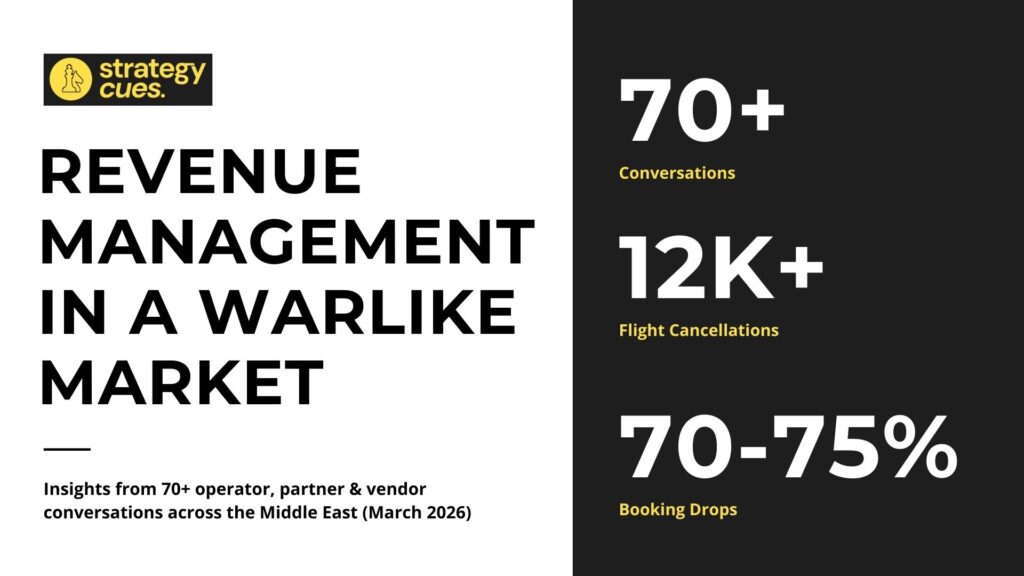
Between February and March 2026, insights gathered from 70+ conversations with hospitality operators, STR managers, partners, and travel vendors across the Middle East revealed a consistent theme: operators are adapting quickly, focusing on smart revenue management strategies instead of panic reactions.
Revenue Management Strategies for Volatile Markets
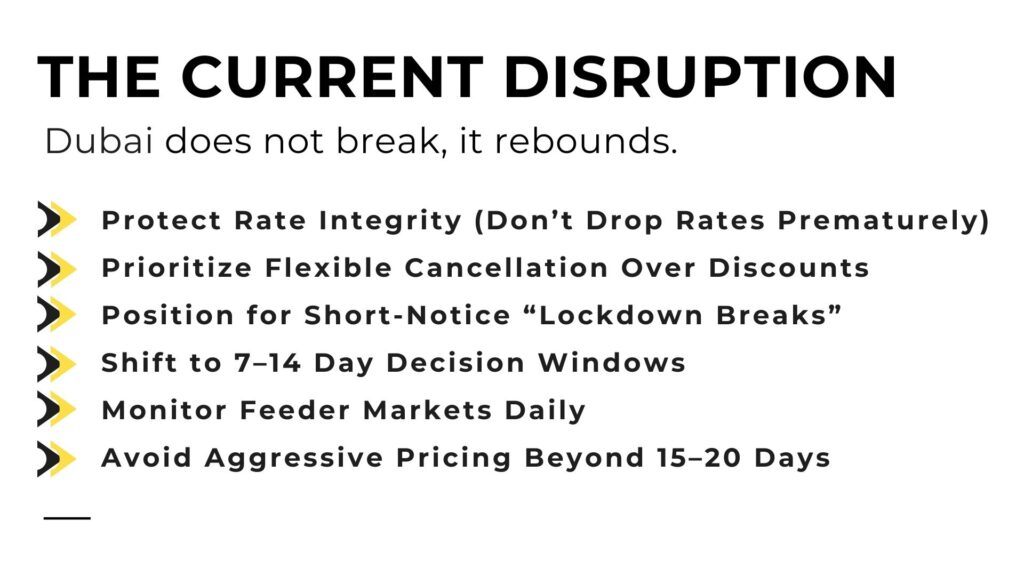
Based on industry feedback, six strategic principles are emerging for hospitality revenue management during geopolitical uncertainty.
1. Protect Rate Integrity
One of the most common mistakes during crises is premature rate cuts.
When bookings slow down, the instinct is often to reduce prices to stimulate demand. However, in the current environment, lower prices will not create additional demand because the issue is travel mobility—not traveler intent.
Instead, operators should focus on maintaining Average Daily Rate (ADR) and protecting long-term pricing power.
Key principle:
Maintain rate floors and adjust booking flexibility rather than lowering prices.
Maintain rate floors and adjust booking flexibility rather than lowering prices.
This protects brand value and prevents a race to the bottom in competitive markets like Dubai hospitality.
2. Prioritize Flexible Cancellation Policies
During periods of uncertainty, travelers value flexibility more than discounts.
Travelers are hesitant to commit to rigid bookings when geopolitical conditions may change rapidly. As a result, listings and hotels offering flexible cancellation policies consistently outperform heavily discounted options.
Major platforms such as Booking.com and Airbnb have already introduced mandatory flexible booking options for many properties.
Key principle:
Increase traveler confidence through flexibility and risk-free booking options.
Increase traveler confidence through flexibility and risk-free booking options.
This strategy protects revenue integrity while improving conversion rates.
3. Prepare for Short-Notice “Lockdown Breaks”
Travel demand tends to rebound in predictable phases after disruptions.
Historically, the first segment to return is the stress-relief traveler—people looking for short escapes after prolonged uncertainty.
These travelers typically book last-minute getaways or short “lockdown breaks.”
Hospitality operators should therefore optimize their listings for:
- Short lead-time bookings
- Instant confirmation
- Quick decision conversions
Key principle:
Prepare for a rapid rebound in short-notice bookings once travel confidence returns.
Prepare for a rapid rebound in short-notice bookings once travel confidence returns.
4. Shift Forecasting to 7–14 Day Decision Windows
Traditional long-term revenue forecasts become unreliable during volatile market cycles.
Instead of projecting months ahead, revenue managers should focus on shorter planning windows.
Many operators are now adjusting their strategies to 7–14 day forecasting cycles, enabling faster response to changing conditions.
Tools like PriceLabs and dynamic pricing platforms allow operators to implement rapid adjustments in real time.
Key principle:
Shorter forecasting cycles lead to faster corrections and fewer revenue mistakes.
Shorter forecasting cycles lead to faster corrections and fewer revenue mistakes.
5. Monitor Feeder Markets Daily
Dubai and the broader Middle East hospitality market rely heavily on international feeder markets.
Demand recovery will depend on how quickly travel advisories ease in key source regions such as:
- United Kingdom
- India
- Saudi Arabia
- GCC countries
- United States
These markets respond rapidly to changes in airspace accessibility, airline operations, and government travel guidance.
Key principle:
Use mobility data and travel advisory trends to guide tactical pricing and inventory decisions.
Use mobility data and travel advisory trends to guide tactical pricing and inventory decisions.
6. Avoid Aggressive Long-Term Pricing Moves
During volatile periods, long-term rate positioning carries significant risk.
Setting aggressive pricing strategies too far into the future—especially for April, May, or peak Q4 travel periods—can limit your ability to adapt as market conditions evolve.
Key principle:
Protect your ability to pivot quickly as visibility improves.
Protect your ability to pivot quickly as visibility improves.
Maintaining pricing flexibility allows operators to capture the inevitable rebound when travel resumes.
Early Signals of Market Recovery
The hospitality sector is closely watching several indicators that historically signal travel demand recovery in the Middle East tourism market.
Early positive signs include:
- Government travel advisories shifting from negative to neutral
- Increased distress and recovery flights returning to regular schedules
- Oil price stabilization roughly 10% below current volatility levels
- Gradual return of medium and long-term travel demand
Interestingly, industry experts expect hotel demand to rebound earlier than short-term rental markets, as corporate and structured travel typically resumes first.
The Long-Term Outlook for Dubai Hospitality
While the current situation is challenging, the underlying strength of the Dubai tourism ecosystem and Middle East hospitality market remains intact.
Dubai has repeatedly demonstrated its ability to recover rapidly after global disruptions—from financial crises to pandemic shutdowns.
Each time, the market has experienced a strong demand surge and inventory expansion within 12–18 months of stabilization.
For hospitality operators today, the focus should not be panic-driven decisions but disciplined revenue management and strategic patience.
Because if history is any guide, the rebound will come—and it will likely come faster than expected.
More About Strategy Cues:
Strategy Cues specializes in delivering Revenue Management and Operational Management support services to hotel brands and holiday homeowners within the hospitality industry. Collaborating closely with commercial teams and executive management, Strategy Cues develops and implements best practices, revenue management techniques, and operational management support services such as – onboarding and property setup advisory, organizational restructure, business plan development, online reputation management etc., to elevate overall profitability. Strategy Cues currently manages over 2,100 listings comprising of both hotels and holiday homes, spread across 11 countries.
